- GEOPOLITIKS
- Posts
- WILL IRAN’S WEAKENING LEAD TO ITS COLLAPSE?
WILL IRAN’S WEAKENING LEAD TO ITS COLLAPSE?
Strategic loneliness, social and economic tensions, no allies and now war – what's going on in Iran?

Joy Pellet
June 19, 2025

Ayatollah Ali Khamenei at the anniversary of the battle of Karbala (Source: Middle East Eye)
For a few years, Iran saw a series of setbacks in its power and influence. The population is tired of the regime and is not afraid to show it. The international community adopted a stricter approach on its nuclear capacities and Israel took military action. While the war is raging, allies remain silent. Are we witnessing the downfall of the mullahs? What’s to expect next for Iran?
Iran’s strategic loneliness
Even though Iran is part of the BRICS and has ties with Russia and China, it is now alone in its war with Israel. Russians and Chinese are not willing to take sides.
China, despite buying 90% of Iran’s oil, maintains a traditional Chinese posture of equilibrium. It calls for de-escalation and asks its nationals to leave, but that's pretty much it.
Russia and Iran signed a strategic partnership in 2025 to boost cooperation in defense with joint exercises and shared intelligence.
Russia condemns Israel's attack but doesn't offer military support. In fact, President Poutine probably seeks opportunities for himself:
Benefit from the turmoil on oil,
Distraction from the war in Ukraine,
Act as a peace broker with the U.S.
Because of this, Iran can only count on itself and its few allies. Although they seem to also be looking the other way.
The collapsed “Axis of Resistance”

Iran and its proxies line up along key shipping chokepoints (Source: Bloomberg)
For a long time, Iran used non-state armed forces to project its power. After the war in Iraq in 2003, it saw the occasion to expand its influence. It used the idea of resistance against the West and the defense of the Shiites. This was called the “Axis of Resistance”. Iran developed ties with forces across Iraq, Lebanon, Syria, Yemen, and Palestinian territory. This allowed the mullahs to use gray-zone tactics: act against regional rivals but avoid full-scale conflict.
But this strategy has been falling apart. Now that a conflict has happened, most proxies are nowhere to be found.
Syria
The Al-Assad regime used to be a key ally. It hosted Shiite militias and served as a supply route for Hezbollah and Hamas. But in 2024, the Assad government was overthrown by the terrorist group Hayat Tahrir Al Sham. The militias ran away and the route to supply Hezbollah was shut down.
Hezbollah and Hamas
These groups have been fighting Israel, but they have lost many leaders and weapons. They need to recover to help Iran, but without its money and logistic, it is unlikely to happen in the short-term. Hezbollah shared condolences to Iran but is staying aside for now.
Yemen houthis and Iraqi Shiite militias
These two allies have opposite standpoints now. On the one hand, the Houthis reaffirmed their support to Iran and fired few ballistic missiles on Israel. On the other hand, Iraqi-Shiite militias are more cautious. Now that they are in good terms with the state and benefit from their position, they rather avoid a conflict.
Iran is also going through difficulties. Since 2024, the country lost its president (most probable successor to Ali Khamenei) to a helicopter crash and Israel damaged:
Air defense systems
Nuclear sites
Missiles stocks and launchers
Key leaders
Key scientists.
Iran can only rely on its ballistic missiles to fight back. Its fighter jets are old and would require in-air refueling but there are not enough tankers. Most forces are infantry, but they are too far away and without air defense they would be easy targets. On top of that, Iran also faces socio-economic turmoil.
Internal turmoil
In March, the UN accused Iran of human rights abuses on its population. These include:
Violence on protesters,
Torture,
No fair trials,
Hardened criminal proceedings on hijab,
Death penalty.
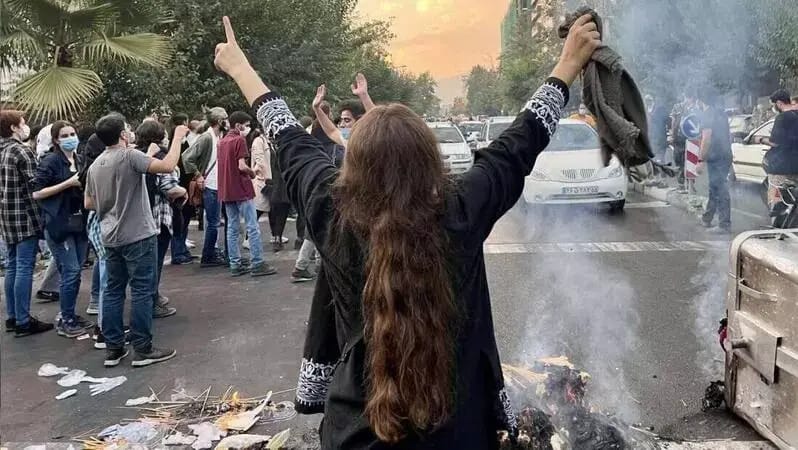
Protest in Tehran after Mahsa Amini’s death (Source: Amnesty International)
In 2022, huge protests began after the death of a young women arrested for not wearing her hijab. These protests mark a shift in Iran’s history. For months, Iranians protested the regime and called to overthrow it. More and more Iranian women now show their opposition by not wearing the hijab. Even shop owners at the bazaar, traditionally very pious and close to the clerics, supported the protests by closing their shops. The regime responded with violence. Over 30,000 protesters were arrested and 551 killed.
Iran resorts to death penalty a lot. In 2024, 975 people were killed (17% more than in 2023). The goal is to punish opponents and deter an uprising.
Along the repression, there is a worsening economy:
Nominal GDP is expected to decline from $401bn (2024) to $341bn (2025) according to the IMF,
Oil exports dropped from 1.7 million barrels a day to only 100,000 since the war began,
Regular power outages and water shortages have an impact on the industry, agriculture, and daily life,
Unemployment rate at 9.5%,
1/3 of the population living in extreme poverty.
In fact, due to all of this, Iran is facing a demographic issue. Its population is aging, and the population growth rate fell from 1.29% (2011) to 0.6% (2023). Young adults leave the country, about 68% say they want to live abroad. This creates a huge brain drain.
What’s next?
Diplomatic and social level
It’s hard to see any big change with the existing regime. International talks and agreements often led to dead-ends, sanctions are tough on the economy, and the population is pressured. This has been going on for more than 25 years now, it is hardly going to change unless a full restructuring is operated at the governmental level.
Military level
Iran will likely not attack the United States. The country already has a hard time with Israel’s attacks and lacks support from its allies. If the U.S. military power came in, it would only be worse for the regime.
At first, Israel's goal was Iran's nuclear plans, but now it seems that the goal is a regime change. While it’s clear the mullahs are no good for the population and stability, let's not forget what history taught us.
Regime changes in almost failed states lead to chaos, as shown by the Libyan or Iraqi cases. Armed groups and terrorists most probably wait for Iran’s fall. Indeed, Iran is surrounded by unstable states.
This would be an awful scenario if such groups took Iran’s weapons, enriched uranium stocks, oil reserves and had access to the strait of Ormuz. This situation would force the West to step in again. It would imply more financial and human costs, and another immigration wave. Extra caution must be taken when aiming for a regime change through military intervention.
Decoding geopolitics isn’t a job. It’s survival.
Joy