- GEOPOLITIKS
- Posts
- The Panama Canal's Strategic Role
The Panama Canal's Strategic Role
How can a 51-mile artificial waterway trigger such competition for its control?

Joy Pellet
July 31, 2025

(Source: CNN)
The Panama Canal is one of the most important waterways in the world. Its control and operation shaped politics for over a century. Due to that, it has long been at the center of the U.S.-China rivalry.
The canal was built and controlled by the U.S. throughout the 20th century. It was part of the Monroe Doctrine and U.S. hegemony on South America. At the end of the century, it was given back to Panama with the Torrijos-Carter Treaties. Under these, the U.S. make sure that the canal remains neutral and provides equal access. Tolls are uniform for all countries and fixed by the cargo value instead of volume. Plus, the canal’s control stays under local power. The Panama Canal Authority is in charge of it. This is a public entity that is not part of government.
Panama remains neutral and non-aligned. But its canal makes it a strategic pivot.
Economic value
The canal is a crucial naval trade artery. It links the Atlantic and Pacific oceans. It allows to bypass the long and costly detour around Cape Horn in Southern Chile. Indeed, it saves more than 8 000 nautical miles.

Map representing the alternate route during droughts. (Source: India Today)
About 6% of global naval trade transits through it. This represents 35 to 40 ships per day and $270 billion worth cargos per year. It eases the transport of goods and raw materials including:
Hydrocarbons,
Minerals,
Cereals.
It also plays a critical role in Panama’s economy in several ways:
Contribution to the domestic GDP up to 6%,
Contribution to government revenues,
Capital investments,
Employment.
Role in U.S. maritime strategy
The U.S. has great interests in the Panama Canal’s control. The U.S. is the canal’s primary user. It is a strategic route for exports and imports between:
The East and West coasts of the U.S.,
The U.S. West Coast and Europe,
The U.S. East Coast and Asia.
More than 70% of the goods passing through the Panama Canal comes from or is destined for U.S. ports.
The canal also plays a key role in the U.S. naval strategy. It is a logistic corridor. It allows to rapidly transfer ships between the Atlantic and Pacific oceans.
The U.S. must prevent any foreign actions that could disrupt the canal. They need to ensure the freedom of movements of goods and military assets. This is crucial for both U.S. economy and defense.
U.S.-China rivalry
The canal is a source of competition between the U.S. and China.
Since the handover by the U.S., China has been expanding its influence. In 2017, Panama cut ties with Taiwan to join China’s BRI. This led to lots of Chinese investments in ports and free trade zones around the canal. The Hong Kong company Hutchison Whampoa operated the container ports Balboa and Cristobal. These are at both ends of the canal. These ports gave China a commercial and strategic foothold. Plus, Huawei and other Chinese tech firms built networks in Panama. This led to worries over data security and digital influence.
But the U.S. warned Panama about being too dependent on China. They are wary about the Chinese “dept-trap diplomacy”. China provides too much loans to low-income countries. With heavy debts, they are unable to repay. This gives China control over key sites.
Panama is quite limited in its freedom of decisions. It has a dollarized economy, a lack of army and is dependent on the U.S. The U.S. can easily influence its decisions. Indeed, the country did not renew its engagement to BRI.
The ports of Balboa and Cristobal are at the heart of this rivalry. American investment firms led by BlackRock were supposed to purchase the ports from Hutchison. President Trump even said that the U.S. took back the waterway from China. But Hutchison stated state the exclusive negotiations with BlackRock had expired. The company said it now explores adding a major Chinese investor in the deal. This decision was probably pushed by China. Beijing will probably not let Panama shift back to the U.S. without a fight.
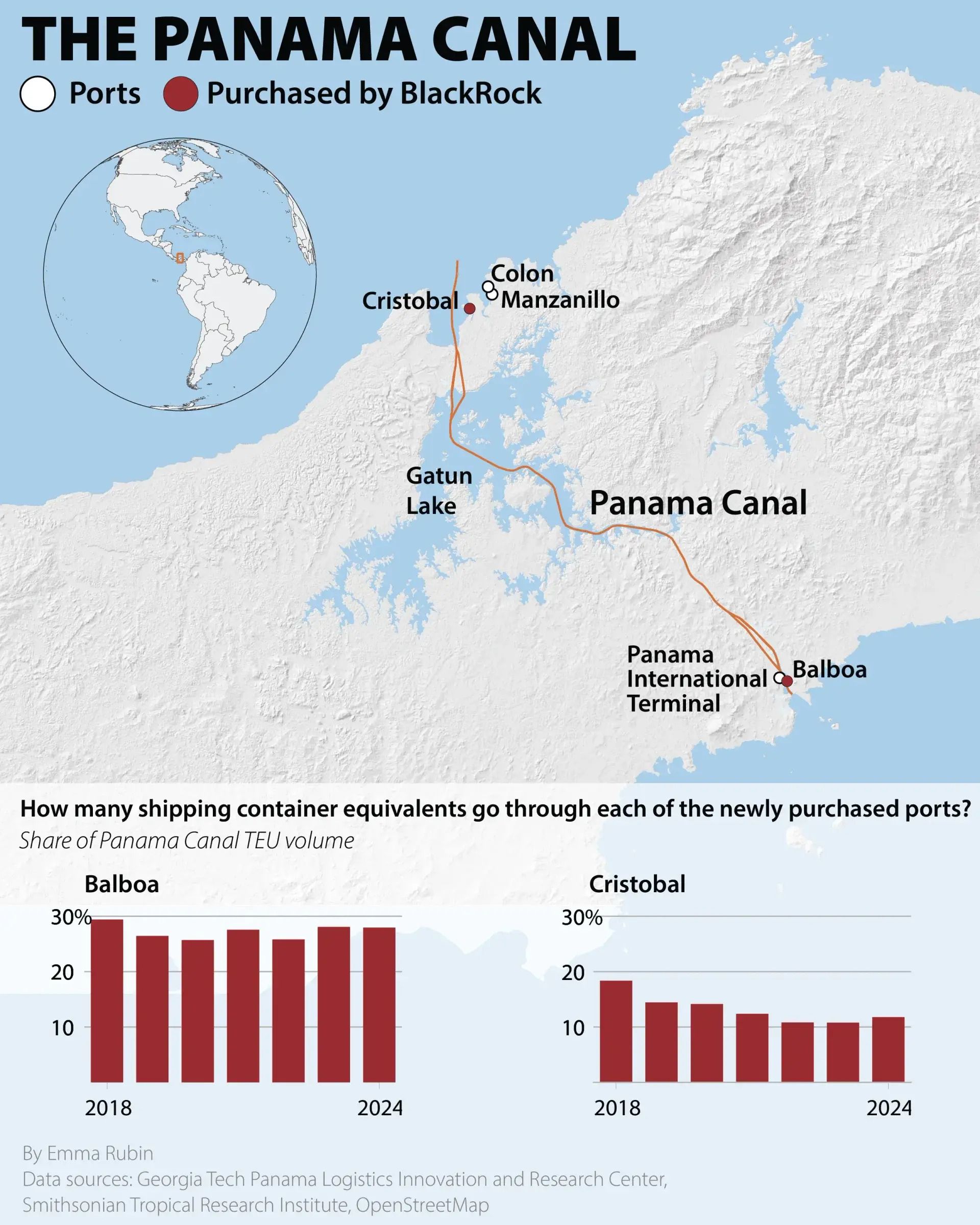
Ports of Balboa and Cristobal (Source: Emma Rubin)
Other potential challenges
The canal depends on freshwater form Gatun Lake for its functioning. But droughts in the past couple of years have reduced ship traffic and weight limits. This triggered global supply chain delays.
Disruptions in Panama could threaten global trade flows. Indeed, Panama is a corridor for drug traffics between North and South America. The criminal networks use naval routes near the canal.
Unlike regions like the Horn of Africa, piracy isn’t a real issue. The waterway is patrolled by the Panama Canal Authority. Plus, local forces also secure the canal. The risk of piracy is assessed to be very low.
Decoding geopolitics isn’t a job. It’s survival.
Joy