- GEOPOLITIKS
- Posts
- The Mandeb Strait: A Threat Hub for Global Trade.
The Mandeb Strait: A Threat Hub for Global Trade.
Iran-backed Houthis, Al-Qaeda, piracy, Yemen war, humanitarian crisis... and only 20 miles wide to safely pass 12% of global trade. What are the challenges in the Mandeb Strait?

Joy Pellet
July 10, 2025

(Source: Shutterstock)
After the ceasefire with Iran, Israel launched strikes on the Houthis. The targets included ports and power plants in Yemen. The attack comes after the Houthis fired ballistic missiles on Israel. They also attacked a bulk carrier in the Red Sea. This reminds us that the Houthis are still a threat for global trade security. They disrupt one of the most important naval chokepoints: the Strait of Bab el-Mandeb.
Let’s see why this corridor is so important, the threats around it and the consequences.
Trade chokepoint
The Strait of Bab el-Mandeb, also known as the Mandeb Strait, connects the Red Sea to the Gulf of Aden and the Indian Ocean. It is about 20 miles wide (18 at its narrowest point). Tanker traffic is limited to 2-mile-wide entry and exit lanes.
This strait is a strategic and sensitive maritime passage. It connects Asia to Europe through the Suez Canal, sparing days of sailing to shipments. About 12% of international trade passes through it. Cargos include:
Crude oil and liquefied natural gas (LNG) from the Persian Gulf destined to Europe or the U.S.,
Manufactured goods (electronics, vehicles, textiles) loaded in Asian ports and bound for Europe,
Food and agricultural products (wheat, rice, sugar, tea),
Strategic goods for global supply chains (industrial spare parts or technological components).
Incidents in the Mandeb Strait can impact global markets, disrupt supply chains, and raise logistic costs. But the region is far from stable and multiple threats surrounds it.
Terrorists and pirates
The most significant threat for the Mandeb Strait is the Houthis. The Houthis are a Shia terrorist group from Yemen. They transformed from local armed group to powerful regional actor. The group is part of the “Axis of Resistance” and backed by Iran. It receives military aid from the latter such as ballistic missiles, drones, and naval drones. They were even the only ally to retaliate against Israel when Iran was attacked in June.

Houthis rebel (Source: Getty image)
In 2015, they took Sanaa and forced the government to flee. As a result, the U.S. and a coalition of Arab countries launched a military operation on Yemen. Ten years of strikes didn’t disturb much the Houthis capacities. But it led to a major humanitarian crisis.
The Houthis still control large parts of western Yemen. They want to control the Mandeb Strait to gain leverage and regional influence. Indeed, they already disturb global trade with their actions.
Since the war on Gaza, the Houthis launched over 30 maritime attacks on commercial ships. The most recent ones resulted in at least 3 sailors’ death.

Key actors and approximate areas of influence in Yemen (Source: U.S. Congressional Research Service)
A branch of Al-Qaeda also operates in the region. Al-Qaeda in the Arabian Peninsula (AQAP) acts in central Yemen. The group is weakened by internal fractures and military campaigns from the U.S. and Arab countries. They mostly attack Yemen’s government and call for lone-wolf attacks on Western soil. Though they use to fight in the past, the relationship with the Houthis cooled. They both follow their own agendas.
While they are not an imminent threat to the Mandeb Strait, they remain a worrying element in the region.
Another threat in the region is piracy. For the past fifteen years, pirate attacks had decreased in the Gulf of Aden. But the Houthis attacks on commercial ships led to a resurgence. Pirates now take advantage of the ships being rerouted. They pursue their attack in the Indian Ocean and along the Somalian coasts.
There is no conflict between the Houthis and the pirates. They even share intelligence on ships heading towards the Red Sea and pirates help in smuggling oil and weapons.
International presence
Due to of its strategic importance, the Mandeb Strait hosts many foreign forces. Several countries have established military bases or facilities in Djibouti:
United States
France
Japan
Germany
China
Italy
Spain
Saudi Arabia.
One of their key missions is to maintain security in the region. Indeed, there are two operations going on in the Red Sea and Gulf of Aden. Their goal is to ensure freedom of navigation and escort commercial ships. But this also has a cost.
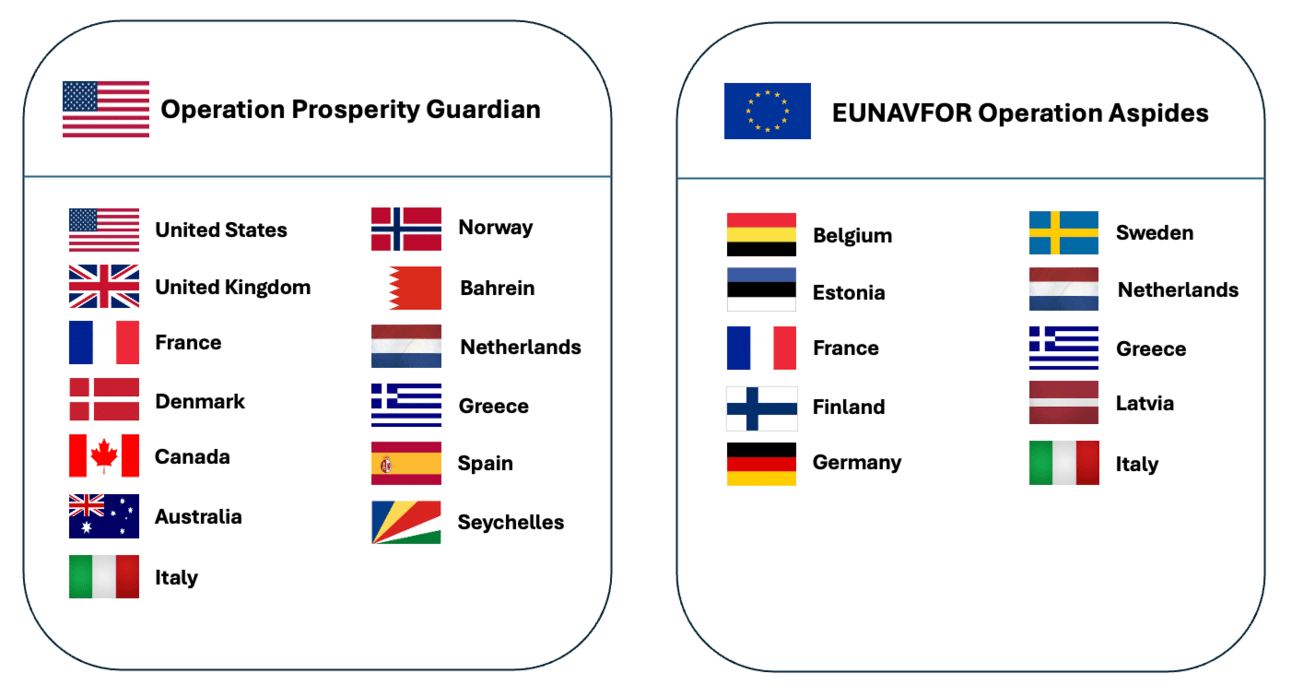
Participating countries in E.U. and U.S.-led operations (Source: U.S. DoD and French Ministry of Defense)
Consequences
All these elements impact global trade on multiple levels:
Delays: ships are rerouted around Africa by the Cape of Good Hope. This adds more than 7000 kilometers and 10 to 15 days to the route. It therefore impacts deliveries, but also costs.
Extra costs: longer routes mean more fuel and supplies for the ships. There are also war-zone premium insurance costs. Onboard security measures and military escorts also adds to the bill. Plus, the more reduced the offer in vessels and qualified personnel for a stable demand, the more prices will go up.
Financial losses: the loss of cargos when ships transporting perishable products (food or medicine) are attacked. Egypt also suffers from a 20% reduction in its income from rights of way on the Suez Canal (9 billion euros per year).
Human concerns: sailors’ lives are at risk with missile and drone attacks, and kidnappings.
Environmental concerns: pollution (ships and their cargos sunk after attacks).
This emphasizes the geostrategic stakes around the Mandeb Strait and the incentive to secure it. But international forces face common problems with non-state enemies: mobility and human shields. Their mobility makes it hard to localize them and their capacities. It is also hard to target them without risking collateral damages when they blend into civilians. Indeed, this has been a major source of concern and controversies for the war in Yemen.
Like most of the threats and conflicts involving non-state actors, the response must be multilayered. Without a combination of military, political and socio-economic answers, the threats on strategic routes like the Mandeb Strait will likely go on.
Decoding geopolitics isn’t a job. It’s survival.
Joy