- GEOPOLITIKS
- Posts
- The Geostrategic Dynamics Around The South China Sea
The Geostrategic Dynamics Around The South China Sea
Oil, gas, fishery, trade routes, defense barrier... What makes that sea so attractive?

Joy Pellet
August 21, 2025

Chinese Coast Guard vessels deploying water cannons at the Philippine military chartered Unaizah May 4 during a supply mission (Source: The Lowy Institute)
The South China Sea (SCS) is a semi-enclosed sea in the Indo-Pacific region. It covers about 1.4 million square miles. Vital trade route and resource-rich area, the SCS is at the center of territorial claims on islands and reefs between China and its neighbors. These raises the complex dynamics in the region with disputes between neighbors and the U.S. back up. Regular show of force and standoffs in the SCS increase the risk of a sudden conflicts.
Let’s have a look at these rivalries and the stakes behind them.
Strategic and economic stakes
The SCS is one of the most resource-rich and important maritime regions in the world.
It accounts for about 12% of the world’s total fish catch. The annual value is estimated at more than $20 billion. This supports the livelihoods of millions of people in Asia. But stocks are declining. This is mostly due to overfishing and illegal fishing by China. Clashes of fishing rights are common between China, Vietnam, and Philippines.
It also hosts about 11 billion barrels of oil and 190 trillion cubic feet of natural gas. These resources could greatly benefit the wealth and economic growth of neighboring countries. But mining is difficult due to claims and China’s actions in neighboring exclusive economic zones (EEZ).

South China Sea oil and natural gas proved and probable reserves (Source: U.S. Energy Information Administration)
The SCS is also a major route for trade. It allows the passage of over 30% of global naval traffic. Over $3 trillion worth of goods are carried annually through it. These include:
Oil and LNG,
Raw materials,
Manufactured goods,
Electronics,
Agricultural products.
It connects Asia with:
Europe,
Africa,
the Middle East,
the Americas.
Any conflict or blockade in the SCS would disrupt global supply chains. The SCS also allows for the shipping of energy coming from the Middle East to Asia. China, Japan, and South Korea rely heavily on these routes for energy security.
These elements lead to a strong military presence from China, the U.S., and its allies. There is a need to control sea lanes to influence regional economies. But also, to secure the freedom of navigation for trade and energy.
Major disputes
Many countries issued territorial claims in the SCS. These include:
China,
Philippines,
Taiwan,
Vietnam,
Brunei,
Malaysia,
Indonesia.
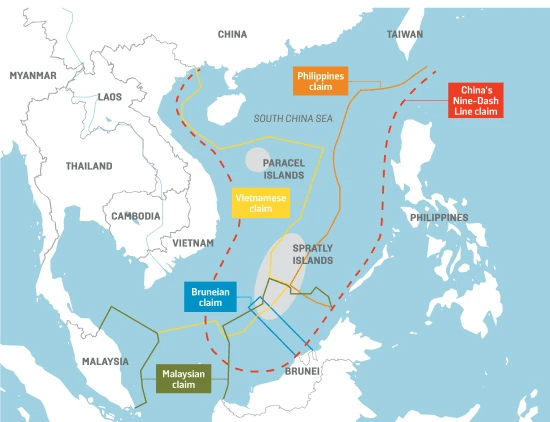
Territorial claims in the South China Sea (Source: ResearchGate)
But China claims 90% of it based on its nine-dash line. This is a U-shaped dash line established by China in the 40’s but presented to the UN in 2009. Through it, China signals its claim over land, water and seabed in the area surrounded by its dash line.
This ultimately affects its neighbors’ EEZ. Indeed, the UN Law of the Sea gives countries 200 nautical miles for their EEZ. This issue already led to several conflicts in the 90’s.

EEZs in the South China Sea as defined by UN Law of Sea (Source: UNCLOS, CIA)
The U.S. acts as a key external power in these disputes. Indeed, Washington sees China as a direct challenge to its dominance. It acknowledges that China is the only competitor with both the intent and power to reshape the international order. So, the U.S. provide its support to counter China’s influence and power over the region. It conducts patrols to challenge China’s excessive claims. It also maintains strong military ties with Japan, Philippines, and other regional partners. Some naval drills are regularly undergone. The U.S. and the Philippines signed the Mutual Defense Treaty in the 50’s. This mandates mutual assistance if either party is attacked.
China’s position
China values the SCS for its national interests. Indeed, this sea is crucial for trades and supplies. About 80% of China’s imports transits through it. Plus, China’s nuclear submarines also transits there.
China sets the boundaries of its maritime and air spaces on its own. It turns reef into artificial islands and settles strategic infrastructures like ports, airports, and radar systems on them.
China also uses different means to control the area. A couple years ago, the Coast Guard Law was passed. It allows China’s coast guards to detain foreign ships and crews for up to 60 days. China also uses grey zone tactics to avoid open warfare. These include the use of fishing fleets and maritime militia. But it also creates influence maneuvers to destabilize local powers and manipulate the public opinion.
The SCS is not the only disputed area in the region. The East China Sea (ECS) is also a source of tensions. Indeed, the ECS are disputed waters between China, Japan, and South Korea. The Senkaku Islands are controlled by Japan but claimed by China and Taiwan. These islands were ceded by the U.S. to Japan in the early 70’s. They were later bought by Japan. This issue often leads to aerial and naval show of force between these countries’ military.
The stakes and tensions in both the SCS and ECS could easily lead to a conflict. There is always a risk of regular standoffs turning into escalation.
Decoding geopolitics isn’t a job. It’s survival.
Joy