- GEOPOLITIKS
- Posts
- Talibans As Officials In Moscow
Talibans As Officials In Moscow
Two decades ago, who would have thought that the Taliban flag would fly over an official Afghan embassy somewhere? Well, it is now in Moscow.

Joy Pellet
July 14, 2025
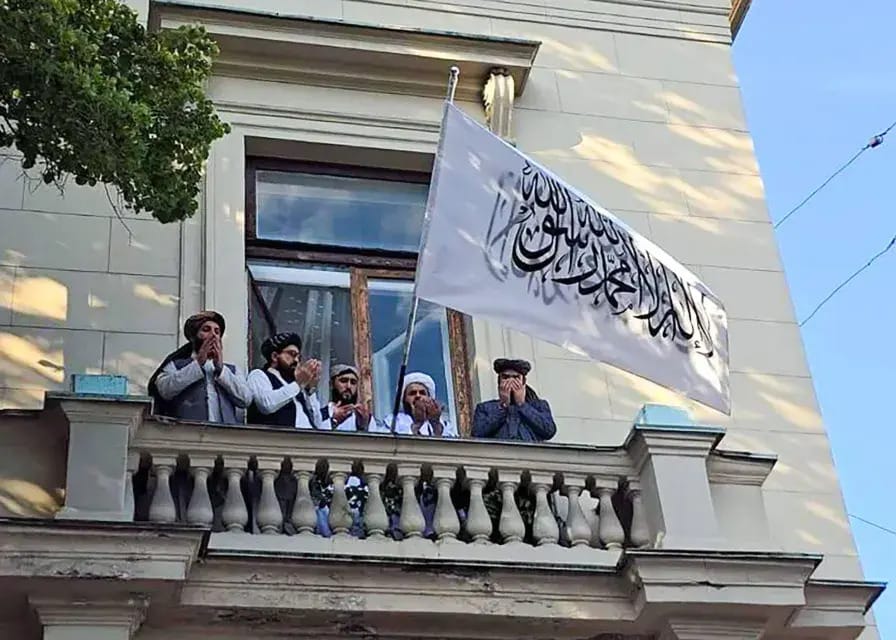
Taliban flag at Afghanistan’s embassy in Moscow (Source: Embassy of Afghanistan)
Russia announced its full recognition of the Taliban government. It is the first country in the world to take that step with the regime. Russia said it will enhance cooperation in many areas such as security and trade. Let’s explore this relationship deeper.
A bit of history
Russia (and the Soviet Union) have an history with Afghanistan.
During the Cold War, the Soviets invaded the country to support a pro-communist government. But they faced a fierce insurgency and were forced out ten years later. Talibans didn’t exist at the time. The Soviets fought islamist fighters - mujahideens. The Talibans formed years later and many of these fighters joined, bringing the memory of the war with them.
Talibans hid Chechen fighters, a threat for Russia’s security. They also attacked a Russian plane and held the crew hostage for over a year.
But relations cooled after Russia took Crimea and invaded Ukraine.
A supportive Russia
When the Talibans took power, Russia did not close its embassy. Russian diplomats started talking with the news leaders right away. Russia was the first to make a deal with them. They agreed to supply oil, gas and wheat.
Talibans also attended economic forums in Russia:
St Petersburg Economic Forum (2022),
Russia – Islamic World Forum (2023 and 2024).
Russian secret services worked with Talibans to fight ISIS.
In April, Russia’s Court took the Talibans off its list of terrorist groups. This laid the foundation for the recognition and the nomination of the Afghan ambassador in Moscow.

The new Afghan ambassador to Russia, Gul Hassan Hassan, hands his credentials to Russian Deputy Foreign Minister Andrey Rudenko (Source: Russian Ministry of Foreign Affairs)
But Russia isn’t the only one developing ties with the Talibans for its own benefit. China is also a key player since the U.S. left.
Russia on one hand, China on the other
China didn’t recognize the Taliban government but it has built ties with them. Since the Talibans took power, China has tried to help the country out of its isolation. A couple years ago, a Chinese oil company even signed an extraction deal with the Talibans. But in return for its help, China asks the Talibans to make their Islamic laws less strict.
China’s goals are economic. Afghanistan is important for its Silk Roads project. So Beijing is going for several objectives:
Keeping the country safe and stable,
Construction deals,
Natural resources deals.
Afghan soil has reserves of lithium, copper, and rare-earth elements. These resources are crucial for Chinese productions. They are also highly needed worldwide. They serve as raw materials for several industries like new technologies, defense, and energy.
China already produces more than half of the world’s minerals. Many countries depend on China for their supply. Thus, it’s in China’s interest to hold grip on Afghan mineral resources and keep its near monopoly.
Consequences
Russia expects several benefits from this relationship. These include:
Security: fight ISIS and secure Central Asia. Russia wants to cool relations between Afghanistan and Tajikistan. A stable region would provide Russia with another route for its trade, by-passing sanctions.
Economic: possible deals in mining, energy, infrastructures, telecoms, work opportunities for Afghans.
Politics: Russia sends a message to the West. It expands its influence on a country where Western nations failed.
While the Talibans have exchanged ambassadors with China and the UAE, those countries do not recognize them as the government of Afghanistan.
Talibans probably hope for a domino effect after a major non-Islamic global power legitimized them. They probably hope that China will do the same. This would help increase their influence and leverage.
Talibans also rely on them to develop the economy. They are under sanctions by Western nations because of human rights issues. Thus, they need support from countries like Russia and China who don’t focus as much on human rights as Western countries do.
To that extent, these ties raise many concerns. Taliban laws on human rights and women rights are terrible. If countries build diplomatic and economic relations despite that, there will be less pressure on them to change. This will comfort them in their current positions. Women and minorities will remain oppressed.
Decoding geopolitics isn’t a job. It’s survival.
Joy