- GEOPOLITIKS
- Posts
- Sudan: a land of crisis
Sudan: a land of crisis
Understanding the situation in Sudan.

Joy Pellet
November 06, 2025

(Source: France 24)
Background of the conflict
The roots of Sudan’s conflict go back many years. Sudan gained independence from Britain and Egypt in 1956. But it soon began to face deep divisions. The north and south had different cultures, religions, and political goals. Two long civil wars followed. The first lasted from 1955 to 1972. The second began in 1983 and ended in 2005. These wars killed millions of people and forced many more to leave their homes.
In 2011, South Sudan became its own state after a vote for independence. This was supposed to bring peace. But new problems soon began for Sudan.
The government in Khartoum faced protests and anger from people who wanted freedom and better living conditions. In 2019, after months of protests, the long-time ruler Omar al-Bashir was removed from power. Many hoped this change would bring democracy and peace.
 | It could single-handedly reshape the global order… dramatically increase U.S. power… and trigger a massive American market boom the likes of which we haven’t seen in 75 years. |
The war between the Army and RSF
After Bashir’s fall, Sudan was led by a mix of military and civilian leaders. They promised to guide the state toward elections. But trust between the groups was weak. In April 2023, fighting broke out between the Sudanese Armed Forces (SAF) and the Rapid Support Forces (RSF). The SAF is led by General Abdel Fattah al-Burhan. The RSF is led by Mohamed Hamdan Dogolo, known as “Hemedti.
The SAF is the main army, while the RSF began as a militia that once fought in Darfur. The two sides were supposed to join into one national army. But they disagreed over power and control. Their fight quickly spread across the country, turning cities into war zones. The capital, Khartoum, became one of the main battlefields. Homes, hospitals, and schools have been destroyed. Many neighborhoods no longer have water or electricity.
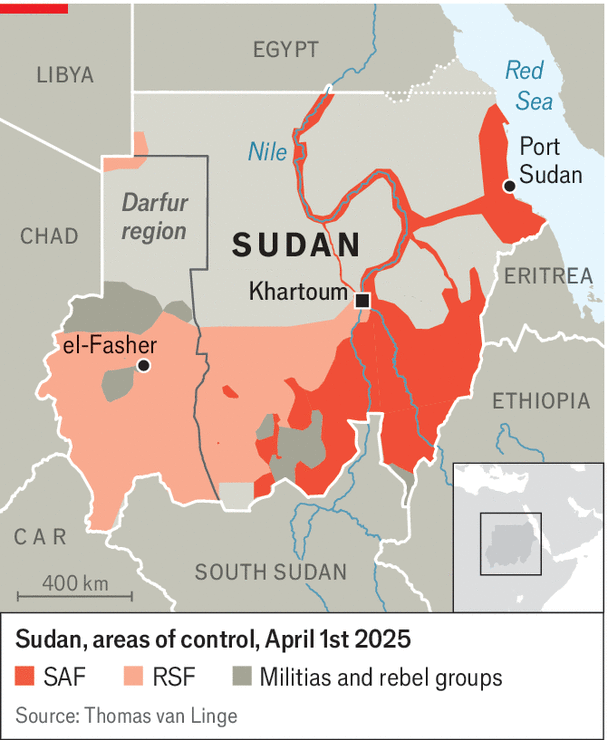
(Source: The Economist)
Resources and supports
Sudan’s soil holds oil and gold reserves. Its port on the Red Sea is also a source of interests. These resources attract some states support. General Hemedti (RSF) is supported by the UAE and Russia. Russia’s militias inherited from Wagner, with Hemedti’s help, control gold mines in the country. On the other hand, Al Buran is supported by neighboring countries such as Egypt and Eritrea. But also, Turkey, Qatar, and Iran. Al Buran is also a strong supporter of Ukraine. He sent arms to Kiev.

(Source: S&P Global)
Current situation
In late October 2025 the war between the SAF and RSF escalated sharply. The RSF captured the city of El Fasher in Darfur after an 18-month siege. This brought the RSF into control of the wider Darfur region.
Mass killings, rapes, and ethnic violence happened during and after the takeover. Huge numbers of civilians are now on the move. Meanwhile, famine conditions have spread. More than 21 million people are now facing severe food insecurity.
At the same time, both combats and arms flows continue despite an existing embargo. The RSF is using long-range drones and advanced weapons systems. The SAF remains under pressure on multiple fronts. The UN has warned that the conflict is spiraling out of control and called for immediate action.
Humanitarian crisis
The war has caused a huge humanitarian disaster. Millions of people have been forced to flee their homes. According to the UN, more than 10 million Sudanese have been displaced. This makes it one of the largest crises of this kind in the world. Many have crossed into neighboring countries such as Chad, Egypt, and South Sudan. Others are trapped inside Sudan. They struggle to find food, water, and medicine.
Hospitals and aid groups are finding it hard to reach those in need. Roads are blocked, and fighting often stops relief convoys. Prices for food and fuel have gone up sharply. Children are especially at risk. Thousands face hunger and disease. The education system has also collapsed in many places, leaving millions of children without schooling for more than a year.
Efforts for peace
Several states and organizations are trying to help Sudan reach peace. The African Union, the UN, and states like Saudi Arabia and the U.S. have called for a ceasefire. Talks have been held. But each side continues to fight. Both the army and RSF say they want peace. But neither wants to give up power.
Local groups inside Sudan are also trying to help. Volunteers risk their lives to deliver aid, care for the wounded, and keep communities informed. Many Sudanese use social media to share news and call for the world’s attention. But internet blackouts and power cuts often make communication difficult.
The future of Sudan
The future of Sudan depends on whether the warring sides can agree to stop fighting. But also, on civilians leading the path to peace. Many experts say that only a government chosen by the people can end the cycle of military rule and rebellion. Sudan’s youth still hope for a better country. One that values freedom, justice, and equality.
But rebuilding Sudan will not be easy. The war has destroyed homes, hospitals, and infrastructure. The economy is collapsing. Millions have lost their jobs or farms. Rebuilding trust between communities will also take time.
Decoding geopolitics isn’t a job. It’s survival.
Joy