- GEOPOLITIKS
- Posts
- Naval mines warfare
Naval mines warfare
Insights on this threat for the Hormuz Strait.

Joy Pellet
March 12, 2026
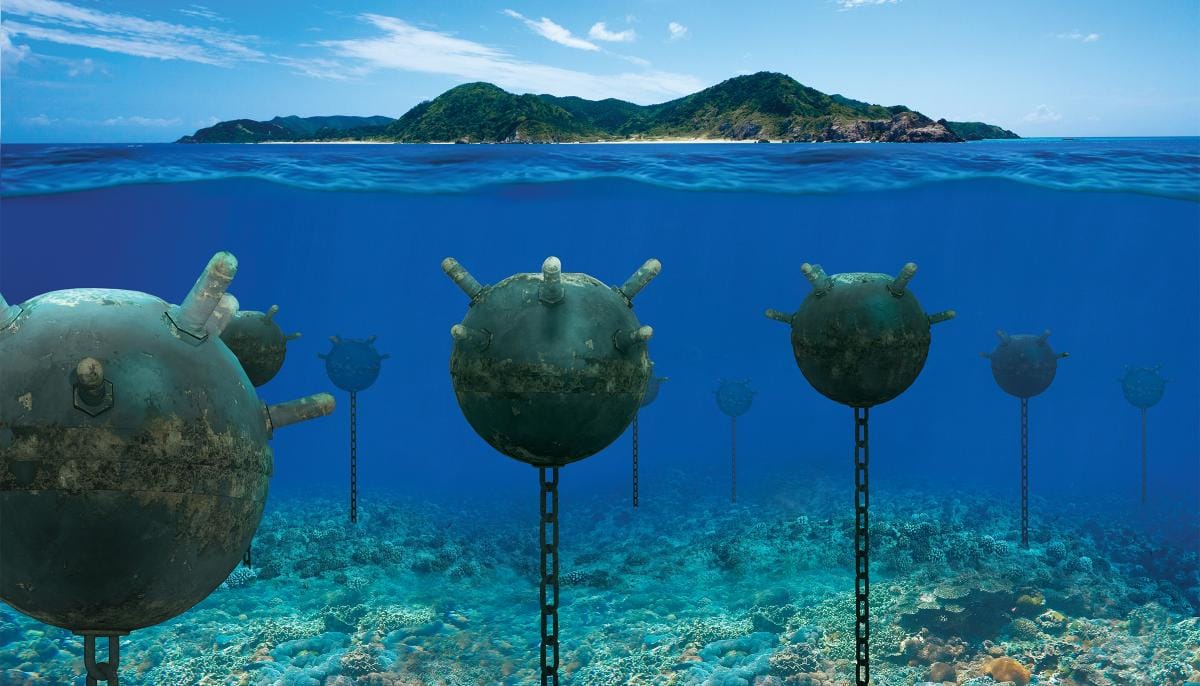
Source: U.S. Naval Institute
Insights on naval mines warfare
Naval mine warfare is the use of explosive devices in the water to damage or deter ships and submarines. It is a quite cost-effective strategy. Relatively inexpensive mines can threaten very expensive ships.
These mines can be placed differently. There are moored mines, anchored to the seabed. There are also bottom mines, they rest on the seabed. Drifting mines float freely. But these latter are mostly illegal. Plus, they are not the most reliable even for the one placing them. They are highly unpredictable. They are on the move, without other control than the sea currents.
There also different types of mines. Contact mines explode when a ship hits them. Influence mines can detect ships without contact. The magnetic version of these mines detects the metal hull. The acoustic version detects engine noise. And the pressure version detects water pressure changes from ships. Some mines can combine sensors to avoid false triggers. Modern mines are more advanced. They can identify ship signatures, communicate with networks, and count ships before detonating.
Naval mines are mostly used for sea denial strategies. Goals include:
· Blocking ports
· Protecting coastlines
· Controlling chokepoints
· Slow amphibious landings
· Get enemies to sail on predictable routes
· Economic disruption
· Psychological pressure
 | How To Profit From Starlink’s $180 Billion IPO Jackpot? |
Why are naval mines a huge problem?
Naval mines are problematic because they can cause damages to expensive ships. Military ships costs millions. Civilian trade ships and their loads often cost millions too. A mine on the opposite costs a few thousands. They are cost effective for the ones who place them. Meaning they can also afford to deploy a large amount of them, compared to missiles. This increases the threat. This also means that even large and advanced navies can be vulnerable to smaller forces assets.
These mines, like land mines, are hard to detect. So, they require slow and risky clearance operations. These operations use minehunters, specialized ships with sonars. Their high frequency sonar scans the seabed and detect mine-like objects. These ships are designed to detect, identify, and destroy mines individually. Drones, explosive disposal divers and mine sweeping methods can also be used. These operations are delicate and dangerous. For that reason, mines also come with a high psychological impact.
Naval mines can cause huge disturbances to commercial shipping. Trade ships do not have minehunters capacities. They are very vulnerable. This method represents a great risk for the ships, their crew, and their loads. Therefore, these ships can be blocked, and deliveries delayed. They can also be forced to reroute on longer alternate route, rising costs. Insurances can also be more expensive due to risks. Ships would need to be escorted by minehunters. But this solution requires more assets than available.
Use of naval mines warfare in the past
Naval mines warfare played a key role during WWII. It has remained a discreet but important part of naval strategies since. It was also used during the Korean and Vietnam wars. During the Tanker War in the 80’s, Iran mined the Gulf waters. A mine nearly sank a US frigate. During the Gulf war, Iraq’s mines caused damages and delayed operations. More recently, naval mines were used in the Russian war in Ukraine.
Focus on Iran and the Hormuz Strait
For Iran, naval mines are key asymmetric naval weapons. They are cost-effective against stronger navies and to disturb trade routes. They fit the regime’s doctrine. Using cheap, disruptive tools to offset technological inferiority. It is assessed that Iran has thousands of naval mines in stock. They are likely placed by the revolutionary guards with their speedboats and minelayers. The U.S. and the regime itself claimed the latter had begun to mine the Hormuz Strait to further block this crucial oil and gas trade route. Reports suggested a few dozen mines had been laid. The number seems modest, but it is sufficient to paralyze maritime traffic even more. Many strikes were then launched by the U.S. against Iran’s naval capacity, particularly minelayers, in the area due to that threat.
As seen, naval mines can disrupt trade. The Hormuz Strait is already under the missiles threat. But naval mines would add to that. This strait is quite narrow, its width varies from about 60 to 24 miles. It is not a huge area to mine and there are no alternate passages.
We can hear in the media some skepticism around the accuracy of Iran’s mining operation. Comments say Iran would not mine the strait because it needs its own ships and China’s commercial ships to pass. This assessment could be true if we were only speaking of drifting mines. Then yes, Iran would not really be able to control them once placed at sea. But these would likely not be the type of mines placed. They would rather use influence or modern mines. In that case, the regime would know where they are placed and could map it. It would allow them to navigate with whatever remains of their navy. It would also allow them to alert their allies on the practicable routes. So, the argument that Iran will not mine the Hormuz Strait for its own sake or China’s is not fully accurate. Plus, mines or not, as long as missiles can be launched by the regime, the Hormuz Strait will remain a dangerous area to navigate anyway.
Decoding geopolitics isn’t a job. It’s survival.
Joy