- GEOPOLITIKS
- Posts
- Geopolitics of the Black Sea
Geopolitics of the Black Sea
Why is the Black Sea a security hotspot?

Joy Pellet
April 02, 2026
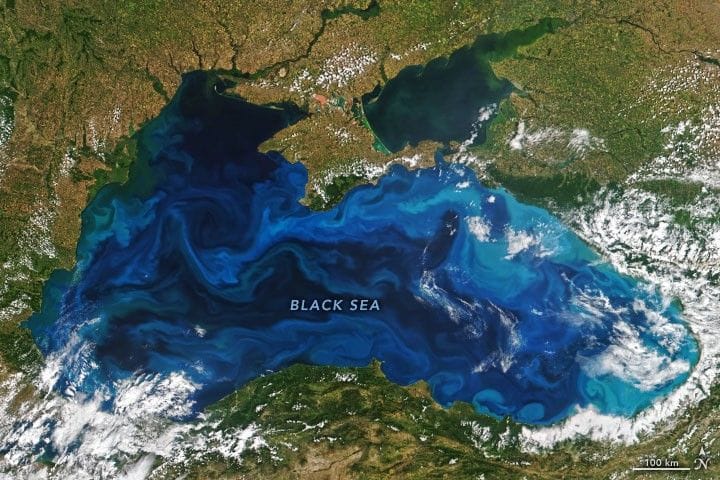
Source: NASA
The Black Sea covers over 168 thousand square miles. It sits between Eastern Europe and West Asia. It is bounded by 6 states:
Russia
Ukraine
Romania
Bulgaria
Turkey
Georgia
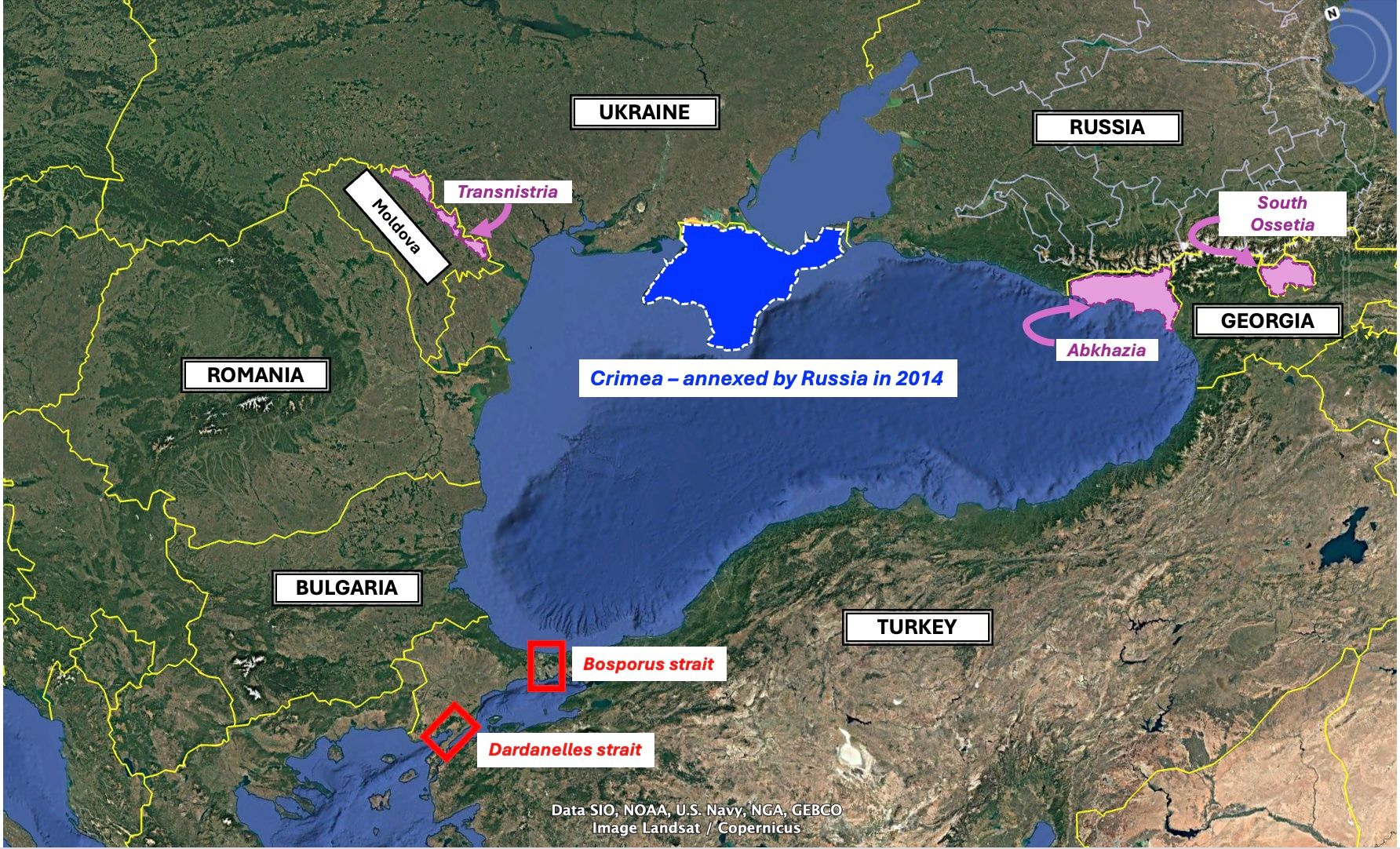
Source: Joy - Google Earth Pro
The Black Sea plays an important role in trade and energy. It contains oil and natural gas resources. But exploration is incomplete. It is also a trade corridor. Ukraine exports grain, crucial for global food security. These shipping routes also connects Eurasian and eastern Europe’s markets to global waters.
Except Russia, all bordering states are either part of NATO and EU or want to join. In Russia’s view, this constitutes a threat for its national security. For NATO and EU, it is key to containing Russia. Let’s see how this rivalry impacts the stability in the region.
Security hotspot
The Black Sea region is far from being a peace haven. The annexation of Crimea and the war in Ukraine showed that this area sits at the heart of great tensions. Since the invasion the Black Sea has become a key military theater. Russia blocked Ukraine’s ports. It also launched missile strikes from there. Ukraine also weakened Russia’s naval power with drone and missile attacks. But Ukraine is not the only concern. Georgia and Russia were at war less than 20 years ago. Since then, two separatist regions are de facto controlled by Russia. These are Abkhazia and South Ossetia. Abkhazia has a long coastline on the Black Sea. Russia uses these regions to maintain influence in the Caucasus. But also, to prevent Georgia’s integration in NATO or EU.
Another frozen conflict that could impact the region is Transnistria. This separatist region is part of Moldova. But it acts as a de facto state since the USSR collapsed. But most of all, Russia exerts a strong influence there.
All these regions under Russia’s influence host Russian troops. These frozen conflicts create more instability and risks of another war in the future.
 | [Urgent] Starlink Set For The Largest IPO In History?
|
Strategic area for Russia
For Russia, the Black Sea is crucial for security and power projection. On a security level, Russia needs to dominate the area. The goal is to create a buffer zone between NATO/EU and Russia. The influence and troops in separatist regions meet this goal. So did the move on Crimea more than a decade ago. It allowed Russia to secure the naval base of Sevastopol. It also allowed to position its military further towards NATO’s eastern flank and Ukraine. But the Black Sea also gives Russia access to the Mediterranean, Middle East, and Africa.
NATO and the EU in the region
For NATO and the EU, the Black Sea is a key stake. It is crucial to contain Russia’s expansion. To do that, they must support Ukraine and Georgia. It is also crucial for them to protect member states and strengthen NATO’s position on the eastern flank. To that extent, Romania is a key NATO hub. It hosts missile defense systems and allied troops. There are also high stakes to protect naval trade routes. This sea connects eastern Europe states to world markets. It is also crucial for Ukraine’s exports.
The EU adopted a strategy on Black Sea security last year. It calls for close cooperation with key players in the region. But this strategy does not provide any concrete action plan, timeline, or budget. It does support Ukraine is its war effort. But a broader robust long-term plan and security presence has not been drafted yet.
Turkey’s key role
Turkey plays a big role in the region. With the Montreux Convention from 1936, Turkey controls two key straits. These are the Bosporus and Dardanelles straits. They allow to exit the Black Sea and access global waters. Turkey regulates the passage of military ships between the Black Sea and the Mediterranean. Under the Convention, civilian ships are allowed to pass freely in peacetime. The rules are different for miliary ships. They can pass through if they belong to a Black Sea country. They still must warn Turkey 8 days in advance. Others have a right to pass in times of peace. But if they want to pass, they must notify Turkey first (15 days before passage). In times of peace, these ships are limited in number, tonnage, and weaponry. They must follow specific rules on their mode of entry and duration of stay. In wartime, or if Turkey feels threatened by war, it can close the straits. This control gives Turkey some kind of power in the war in Ukraine. Since the war began, Turkey refused passage to Russian ships. But also, to minehunters given by the Royal Navy to Ukraine.
China, discreet but here
China is not a Black Sea country. But it has been expanding its presence and influence. This is mainly part of China’s economic diplomacy through the Belt and Road Initiative. China sees the Black Sea region as a crucial transit hub between Asia and Europe. Its presence is mostly visible through investments, loans, and trade rather than security deployments.
Decoding geopolitics isn’t a job. It’s survival.
Joy